What you pay the county. What inspectors check before you cover the work. How to spot a wider drainage problem.
We’ve dated every figure. Where the county’s documents leave a question open, we say so.
Do you actually need a permit?
Describe the work, not just “basement waterproofing.” Howard County’s plumbing application lists sump pumps, sewer ejectors, trench drains, and storm sewer or clear-water waste piping separately. They are different jobs, even if a salesperson puts them in the same proposal.
If your contractor is installing a sump or drainage piping, expect to need a plumbing permit. The application asks for fixture quantities, pipe materials and lengths, and the responsible plumber’s licence details. You also agree to leave the work exposed for inspection. Make sure the permit description names the pump installation. A general promise to dry your basement is not enough.
Check foundation changes, electrical work, and exterior digging separately. The county handles building, electrical, plumbing, and grading permits separately. Tell DILP whether you’ll cut the floor, change the foundation, add pump power, dig outside, or change the discharge route.
We could not settle this one. We found no county policy covering every interior drainage retrofit or crack-sealing job. We cannot say they all need permits or are all exempt. Treat pump and piping work as plumbing work. Ask DILP whether you need a building permit for your work at 410-313-2455, option 4. Calling it a “repair” does not answer that question.
Source: Howard County DILP, Plumbing & Gas Permit Application, revised 2017-03-29 and currently linked by the county; Licenses & Permits Division, undated. Gathered 2026-09-22.
What the permit costs
The FY27 schedules took effect July 1, 2026, under Council Resolution 83-2026. These are government charges, not installed waterproofing prices.
| Plumbing item | Published charge |
|---|---|
| Filing fee, except express plumbing | $50, nonrefundable |
| Residential minimum, including first fixture | $25 |
| Additional ordinary fixture | $5 |
| Sump-pump replacement, listed as an exception | $25 each |
| Express plumbing, up to 5 fixtures | $50; separate filing fee excluded |
| Technology fee | 10% |
Do not read the replacement row as the entire bill. The schedule lists express permits and replacement charges without fully explaining how they overlap. It also leaves unclear whether the plumbing technology fee applies to filing charges. We read these as separate entries, not a guaranteed combined price. Ask DILP to classify your job at 410-313-2455, option 4. Get them to confirm the total.
You may also need a building permit. These charges apply if the county classes your work as an alteration or repair to an attached or detached single-family dwelling:
| Building alteration or repair item | Published charge |
|---|---|
| Filing | $25, nonrefundable |
| Single/small room or area, 200 square feet or less | $50 |
| Larger category, over 200 square feet | $100 |
| Technology fee | 10% |
The larger category also refers to more than a single floor or area. These area-based fees depend on how the county classifies your work. We cannot assume it measures an interior perimeter trench by its footprint, the whole basement, or wall area. Get that settled during the permit review, before anyone promises an exact total.
Ask for county charges to be listed separately from the contractor’s charge for handling permits. Otherwise, you cannot check a “permits” line against either schedule.
Source: Howard County DILP, FY27 Plumbing Permit Fee Schedule and FY27 Building Permit Fee Schedule, Council Resolution 83-2026, effective 2026-07-01. Gathered 2026-09-22.
Exterior digging has a separate grading question
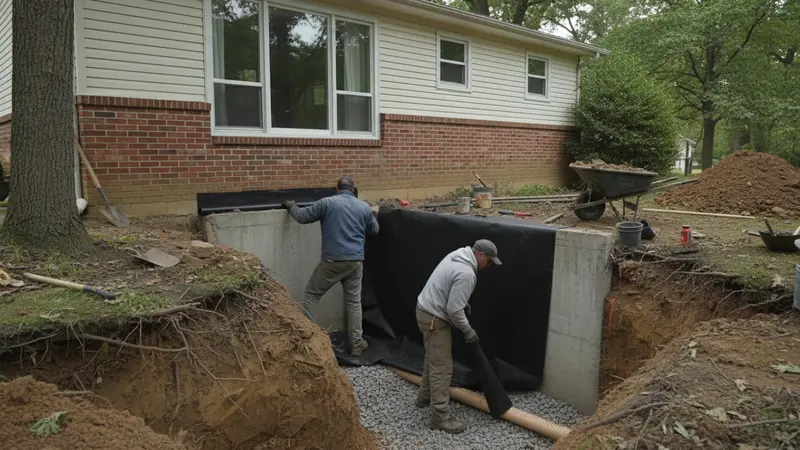
Ask your contractor to show where they’ll dig for exterior waterproofing. Get them to show where water will flow afterwards. Howard County’s May 2026 grading checklist asks for existing and proposed grades, drainage patterns, and limits of disturbance on individual plot plans. You need to address where the water goes in the paperwork, before digging starts.
“Exempt” does not clearly mean “no paperwork.” The checklist includes exempt grading with no fee. Its shorthand threshold is less than 5,000 square feet / 100 cubic yards / 100 linear feet of utility trenching. It still lists an application, a standard sediment-control plan, and plot plans. Do not assume those slash-separated measures are interchangeable exemptions. They do not give you the go-ahead to dig. Ask DILP which category fits at 410-313-2455, option 4. Check what you need to submit.
If grading fees apply, the current schedule lists:
| Grading item | Published charge |
|---|---|
| Standard sediment-control plan for minor grading | $50 |
| Filing for that standard plan | $50 |
| Other grading/drainage/erosion-control permit calculation | 9% of the county cost estimate |
| Filing for the cost-estimate route | $50 |
| Technology fee | 10% |
The county calculates the estimate using its unit rates with the quantities you submit. It is not simply your waterproofing company’s contract price. What you submit can also affect whether you need extra plan reviews or a surety.
For the standard-plan route, the checklist prints a $105 fee. The current fee schedule lists permit, filing, and technology charges separately. The county’s worksheet applies technology to the permit fee before adding filing. That supports $50 + $5 + $50 = $105, if the county approves the standard-plan route. It is not a fee for every exterior waterproofing job.
Source: Howard County DILP, Grading Permit Application Checklist, May 2026; FY27 Grading Permit Fee Schedule and Grading Surety Rates, fee provisions effective 2026-07-01; FY27 Grading and Sediment Control Cost Estimate. Gathered 2026-09-22.
The inspections, and when the work can be covered
The county’s inspection menu includes these codes. Your waterproofing job will not necessarily need every inspection listed.
| Code | Inspection |
|---|---|
| 201 | Damproof & Draintile |
| 202 | Draintile |
| 208 | Foundation Walls / Dampproof |
| 712 | Plumbing Groundwork |
| 720 | Plumbing Rough In |
| 705 | Final Plumbing |
Book by phone at 410-313-3800, or text Schedule to 888-297-9841. Once your permit is issued, you can request the next day or up to seven working days ahead. That does not guarantee a slot.
For a two-hour arrival window, call 410-313-1823 between 7:30 and 8:30 a.m. on inspection day. For plumbing inspection questions, call 410-313-1840.
The plumbing application requires 24 hours' advance notice when your work is ready. Do not cover it before the required inspection. Allow for that pause before you book the slab patch or backfill.
We could not find a reliable permit turnaround time specifically for waterproofing in Howard County. Inspection booking instructions do not tell you how long permit approval takes.
Source: Howard County DILP, Automated Inspection Request and Permit Information System / Inspection Scheduling Instructions, combined brochure posted April 2025, phone-instruction sheet internally dated 2024-12-27; Plumbing & Gas Permit Application, revised 2017-03-29. Gathered 2026-09-22.
What the inspector is actually going to check
Howard County’s residential inspection criteria distinguish dampproofing from waterproofing:
- Masonry enclosing usable space needs 3/8-inch Portland-cement parging. It also needs approved dampproofing from footing to finished grade.
- High groundwater or severe soil-water conditions call for an approved waterproofing membrane over concrete or parged masonry. Its joints must be sealed and lapped.
- Drain tile must sit at or below the area it protects. It must drain to an approved system. It needs at least six inches of gravel cover. Exterior tile and gravel need filter protection.
- Sump discharge needs a splash block or another approved destination with a properly graded outfall.
Check these details in your proposal before the work disappears beneath soil or concrete.
The retrofit rules are not entirely clear. The undated checklist specifies 2-inch pipes at 4-foot centers through the foundation when interior tile replaces exterior tile. It does not distinguish all retrofit systems from new construction. Do not take that checklist as permission to drill your existing foundation. Ask DILP whether it applies through its Inspection Requirements page. Confirm the approved detail with them.
Source: Howard County DILP, Inspection Requirements, Residential Building—Damproofing and Draintile; Residential Plumbing—Final, undated checklist. Gathered 2026-09-22.
Who is allowed to do the work
Maryland’s Home Improvement Commission lists waterproofing, sealants, excavating, and grading as work that ordinarily needs an MHIC licence. Contractors signing home-improvement contracts with homeowners must be licensed. Home-improvement subcontractors can work under an MHIC-licensed contractor without a separate MHIC subcontractor licence.
That does not tell you who is responsible for the plumbing. The county’s plumbing application separately asks for the responsible professional and their Maryland plumbing licence number. Make sure your proposal names the contracting business. It should also name whoever handles the plumbing application.
If you’re doing it yourself, the rules are narrower. The county’s homeowner plumbing form is for owner-occupants doing the work themselves. You cannot use it to employ someone else. It excludes exterior work, gas work, and connections between your home and public or private water or disposal systems. It lists $50 plus $5 technology, totaling $55.
We could not reconcile the form with the adopted law. Council Bill 26-2025, section 3.301(d), exempts certain homeowner plumbing work you do yourself from permits, with conditions. You must tell the county in writing. You must build to code. You must let an inspector in. The March 9, 2026 form calls itself a homeowner permit. It charges a fee. We found that process and charge, but could not settle how they fit the exemption. Do not assume the exemption has gone away. Do not assume you can skip submitting paperwork either. Check your work with Plumbing Inspections at 410-313-1840.
Source: Maryland Department of Labor, MHIC, What Is Home Improvement? and Commission overview, undated; Howard County DILP, Homeowner Request for Plumbing Work, finalized 2026-03-09; Howard County Council, CB26-2025 final, effective 2025-09-07. Gathered 2026-09-22.
Which code your job is held to
The 2024 International Residential Code and 2024 International Plumbing Code, with county amendments, took effect on September 7, 2025 in Howard County. Electrical work falls under the 2023 National Electrical Code and local amendments, effective June 3, 2024.
Ask which approved details apply to your foundation, drainage, and any new electrical work. A product brochure does not answer that. Make sure your scope of work says which county reviews you need. Keep the approved drawings with your permit records.
An older county form’s revision date is not the date the technical code took effect. Check the county’s current adoption list alongside your job’s documents.
Source: Howard County DILP, Adopted Codes, current adoption list; CB24-2025 and CB26-2025 effective 2025-09-07, electrical adoption effective 2024-06-03. Gathered 2026-09-22.
What Howard County houses are, and what can be wrong around them
The Census Bureau’s 2020–2024 ACS five-year estimates count 125,286 housing units in Howard County. Maryland publishes them in its county profile. The largest construction decade is 1980–1989: 28,675 units, or 22.9%. Another 21,050 units date to 1970–1979. A further 23,487 date to 1990–1999.
Those figures include vacant homes. They are estimates. The reported margin of error for the 1980s count is ±1,155 units. They cannot tell you which houses have basements, failing drains, block foundations, or original waterproofing. We found no countywide figure for how common wet basements are. A house’s age alone cannot tell you why it leaks.
For an older house, check past drainage permits. Find out where the sump discharges. Look for changes in the garden or basement before the water appeared. Ask whether the proposed work tackles an observed entry point or assumes one from your house’s age.
The county’s stormwater guidance gives you a useful starting point for a sump that runs continuously:
- Check that downspouts discharge away from the foundation.
- If you suspect a broken water line, involve the Bureau of Utilities.
- If groundwater is high, ask the Howard Soil Conservation District about your property’s soil conditions.
That guidance points you towards finding the water source before choosing equipment. It does not mean every busy sump is too small. It does not tell you that every wet wall needs excavation, either.
Outside your house, who you need to speak to depends on the problem. The county directs excessive surface flow to Construction Inspection. For drainage infrastructure in county easements, it directs you to Highways. County open-space issues go to Recreation and Parks. Columbia Association land issues go to the association. The property receiving the water may need a different remedy from the one causing the problem.
Source: U.S. Census Bureau, 2020–2024 ACS five-year estimates, Howard County profile published by Maryland Department of Planning, Selected Housing Characteristics, Year Structure Built; Howard County Bureau of Environmental Services, Stormwater Management, undated resident guidance. Gathered 2026-09-22.
Flood exposure is a separate question from foundation seepage
Howard County names Main Street, Elkridge, and Allview Estates among places that flood occasionally. Its guidance describes flood risks along the Patapsco and Patuxent systems and their tributaries. It also warns that standing floodwater can collapse basement walls or buckle a floor.
Check whether your quote tackles groundwater seepage, surface water entering the building, or both. A promise to control sump water does not tell you what happens when floodwater reaches openings above it.
Flood maps are changing. On September 22, 2026, the county described the new FEMA maps as preliminary. It treats preliminary hazard data as the best available data for its floodplain rules. It expects the final maps to take effect around September 2027. That is an estimate, not a date already in force.
For help interpreting your property’s map and drainage, the county lists DoIFlood@HowardCountyMD.gov and 410-313-6444. Your neighbourhood’s name alone cannot tell you your flood exposure or what restrictions apply to proposed work.
Source: Howard County Bureau of Environmental Services, Flood Protection, current preliminary-map notice and local flood guidance; no single page effective date stated. Gathered 2026-09-22.
What the work is worth, and what belongs in the quote
We found no primary-source installed prices for Howard County interior drainage, exterior foundation waterproofing, or sump replacement. We cannot give you a supported local price range. County permit fees cannot stand in for labour, excavation access, restoration, or equipment costs.
Maryland requires a written home-improvement contract describing the work and materials. It must include approximate start and substantial-completion dates. To compare waterproofing proposals, ask for the drainage route and outlet. Get the pump and basin specified. Include the membrane if one is proposed. Settle how the floor will be restored. Do the same for areas dug up outside. Agree who handles permits. Settle who books inspections. These are suggested details, not an exact list required by the state.
Read your warranty against the agreed work. Check whether it covers the drainage installation, pump equipment, water entering elsewhere, and repairs to finished surfaces. A long warranty title does not tell you what you’ll get if something goes wrong.
The state’s payment rules are firm: no payment before the contract is signed. There is also no deposit greater than one-third of the contract price before or at signing. Put later payment terms in your agreement. The initial limit does not set every later instalment.
Source: Maryland Department of Labor, MHIC, Maryland Home Improvement Contracts, undated current guidance; Maryland General Assembly, Business Regulation §8-617, current statute. Gathered 2026-09-22.